Last time, in discussing Mollie Williams and St. Joseph prostitution, I mentioned, or at least implied, that, even though prostitution was nominally illegal, a sort of de facto licensing system existed whereby prostitutes and keepers of bawdy houses were periodically fined but then allowed to go right back to doing business as usual. I thought I might go into a little more detail this time about the extent of prostitution in St. Joseph in the late 1800s and how the ladies of the night were treated by law enforcement.
A St. Joseph Herald newspaper article from February 1889 sheds quite a bit of light on this question. The reporter suggested that while St. Joe was rightfully proud of its educational institutions, churches, and charitable organizations, the town was also "cursed with a population that numbers into the hundreds, that are entirely without the pale of society--the courtesan." The reporter's estimate of the number of scarlet women is probably not an exaggeration, because nine years earlier the 1880 census listed at least 27 women with the occupation "prostitute." Not only had the number probably increased since 1880, but those listed in the census with the title "prostitute" obviously represented only those that openly practiced their profession and did not include those women who were still trying to maintain a veneer of respectability.
The Herald reporter was not particularly alarmed by the fact that prostitution existed in the city. In fact, he thought the extent of prostitution in St. Joe was no greater than it was in almost any other city of comparable size. However, the fact that prostitution had spread throughout the entire city and was not confined to a certain area was an evil that called for a remedy.
Only four established houses of prostitution existed in St. Joseph at the time of the article. The "landladies" of these places were Minnie Dixon at 777 Jule Street, Mollie Williams on Main Street between Francis and Jule, Ellen Hardy on Jule between Main and Second, and "Dutch Ella" at 317 Main Street. Minnie's place had eight or ten inmates, Mollie's had six or seven, Ellen's had between ten and twelve, and Ella's place housed ten girls.
These women were arrested every three months. The keepers were fined $50 each, while the prostitutes were usually fined $8 each. This brought in a total of about $2,000 per year for the city coffers. The police chief told the reporter that these four places were "properly kept" with disturbances rarely occurring at them. In addition, these four houses were all located within a radius of one or two blocks of each other in an old, downtown part of the city where very few families resided and where not much business was transacted.
The problem, as the reporter saw things, was that it was very difficult to confine prostitution just to this relatively small area. Although the four places mentioned above were the only ones openly doing business as places of prostitution, numerous boarding houses throughout the city had become assignation spots for freelance prostitutes who roomed in those houses. In fact, when the reporter asked a police official whether the prostitutes at the four downtown houses represented the bulk of St. Joe's scarlet women, the official replied, "No, not one-tenth of them. They are scattered from one end of the city to the other. They may be found next door to the millionaire, the minister and the merchant."
The police official complained that it was difficult to control these freelance prostitutes disguised as "roomers" unless they engaged in boisterous conduct or broke the law in some other manner that drew police attention. The reporter thought the best way to deal with prostitution was by instituting a licensing system that legalized the "social evil" but confined it to a certain area of the city and cracked down on those who tried to expand it to other parts of the city.
In 1890, there apparently was an attempt to crack down on prostitution in St. Joseph. First the amount of the fine that madams had to pay quarterly was increased to $200 instead of $50. Then, a local judge ruled that the "landladies" would no longer be allowed to simply plead guilty, pay their fines, and go back to the sporting life. Instead, they would have to face trial. The new law, however, had little practical effect in reducing prostitution or punishing offenders, because when the madams were tried for the first time after the judge issued his ruling, at the summer 1890 term of court, the jury assessed the same fine ($200) that the women had previously been accustomed to paying.
In the fall of 1890, five madams, including the four mentioned above, were arrested and charged with keeping bawdy houses. Four of the five, including Mollie Williams, were allowed to plead guilty and pay fines of $262.50, while Ellen Hardy escaped having to pay a fine by dying. So much for the judge's new rule requiring that the madams face trial by jury.
Friday, November 4, 2022


Sunday, October 30, 2022
St. Joseph Prostitution, Part One: Mollie Williams
When I was researching and writing my Wicked Joplin book https://amzn.to/3X6gmuS, I was struck by how much prostitution there was in Joplin during its early days, particularly the late 1880s, and how open it was. Joplin, though, wasn't the only town in Missouri where "the oldest profession" flourished. St. Louis and Kansas City, the state's largest cities, are two examples, but St. Joseph is perhaps a less obvious example. St. Joseph was about two to three times as populous as Joplin during the 1880s and 1890s, but it probably had at least two to three times as many prostitutes as well. And, if anything, prostitution was even more open in St. Joe than it was in Joplin. A whole slew of women were even listed with the occupation "prostitute" in St. Joseph in the 1880 census.
Joplin, of course, was a rip-roaring mining town in its early days that drew a lot of young, single men, and anywhere there was a concentration of young, single men, whether it was a mining camp or a military post, women willing to entertain them for a fee were bound to follow. I suppose the prevalence of prostitution in St. Joseph was a carry-over from its early days as a bustling frontier town, when it was the western-most railroad terminus in the United States and a jumping off spot for people headed west on the Oregon Trail.
One prominent St. Joseph lady of the night during the 1880s and 1890s was Mollie Williams. Mollie first made the news in November of 1879 when she and Mattie Leftwich, one of her fellow bauds, were mentioned in connection with a larceny charge against a man. In 1881, Mollie was cited for "keeping a bawdy house," and she was cited numerous times over the next ten years or so for the same offense or for being an inmate of a bawdy house. For the latter offense, she was usually fined about $10, while the former carried a stiffer fine of $100 to $262.50. In most cases, Mollie simply pled guilty, paid the fine, and went back to business. That's how it apparently worked. All the madams and prostitutes in St,. Joe were periodically fined (usually at each quarterly term of court) and then allowed to resume their sport. It was more or less a de facto system of licensing, which was similar to how Joplin officials also treated prostitution in the late 1800s and early 1900s.
Occasionally, Mollie made the news for reasons other than being charged with prostitution or keeping a bawdy house. For instance, in May 1884, Zell, "an inmate of Mollie's "maison de joie," as the St. Joseph Gazette-Herald called her place at 118 Main Street, complained to police that she had been attacked with a wine bottle by a "sister in sin" named Vic, who also boarded with Mollie. In July 1885, Mollie was cited for disturbing the peace, and in November 1886, she was charged with selling liquor without a license.
About six a.m. on the morning of January 16, 1888, "five bloods supposed to be from the wicked city of Leavenworth, entered the palace of sin run by Mollie Williams on Main Street," according to the Gazette-Herald, "and proceeded to wind up an all-night spree by tearing through the house and making mischief generally." Angered by the quintet's behavior, Mollie summoned authorities and caused the hell-raisers to be arrested. They paid fines of three dollars each and headed back across the river to Kansas.
More to come next time about St. Joe prostitution.
Joplin, of course, was a rip-roaring mining town in its early days that drew a lot of young, single men, and anywhere there was a concentration of young, single men, whether it was a mining camp or a military post, women willing to entertain them for a fee were bound to follow. I suppose the prevalence of prostitution in St. Joseph was a carry-over from its early days as a bustling frontier town, when it was the western-most railroad terminus in the United States and a jumping off spot for people headed west on the Oregon Trail.
One prominent St. Joseph lady of the night during the 1880s and 1890s was Mollie Williams. Mollie first made the news in November of 1879 when she and Mattie Leftwich, one of her fellow bauds, were mentioned in connection with a larceny charge against a man. In 1881, Mollie was cited for "keeping a bawdy house," and she was cited numerous times over the next ten years or so for the same offense or for being an inmate of a bawdy house. For the latter offense, she was usually fined about $10, while the former carried a stiffer fine of $100 to $262.50. In most cases, Mollie simply pled guilty, paid the fine, and went back to business. That's how it apparently worked. All the madams and prostitutes in St,. Joe were periodically fined (usually at each quarterly term of court) and then allowed to resume their sport. It was more or less a de facto system of licensing, which was similar to how Joplin officials also treated prostitution in the late 1800s and early 1900s.
Occasionally, Mollie made the news for reasons other than being charged with prostitution or keeping a bawdy house. For instance, in May 1884, Zell, "an inmate of Mollie's "maison de joie," as the St. Joseph Gazette-Herald called her place at 118 Main Street, complained to police that she had been attacked with a wine bottle by a "sister in sin" named Vic, who also boarded with Mollie. In July 1885, Mollie was cited for disturbing the peace, and in November 1886, she was charged with selling liquor without a license.
About six a.m. on the morning of January 16, 1888, "five bloods supposed to be from the wicked city of Leavenworth, entered the palace of sin run by Mollie Williams on Main Street," according to the Gazette-Herald, "and proceeded to wind up an all-night spree by tearing through the house and making mischief generally." Angered by the quintet's behavior, Mollie summoned authorities and caused the hell-raisers to be arrested. They paid fines of three dollars each and headed back across the river to Kansas.
More to come next time about St. Joe prostitution.
Saturday, October 22, 2022
Lizze Reed's Resort
I recently read in the Joplin Globe that Len Rich, a Webb City marshal who was killed on August 10, 1902, at a place in Webb City called "Lizzie Reed's resort," was getting an additional marker installed 120 years later at his gravesite in Mount Hope Cemetery to memorialize the fact that he was killed in the line of duty. More about that incident later, but it turns out that Rich's murder was not the first notorious incident that happened at or in connection with Lizzie's place.
A two-story structure located on Main Street (now Broadway), Lizzie's resort was a house of ill repute that catered to the rowdy young men populating the mining town of Webb City. Not all places that earned the moniker "house of ill repute" in the late 1880s and early 1900s were what many people today might think of as houses of prostitution. Many were merely boarding houses where some or all of the female tenants had questionable reputations but were not necessarily prostitutes in the professional sense of the word. It's not altogether clear exactly where Lizzie's place fell on this continuum of ill fame, but hers was apparently pretty close to an actual house of prostitution.
In the early morning of July 27, 1900, about a year and a half before the marshal was killed at Lizzie's resort, "a young girl of questionable character" named Lillie Garrison (aka Pearl Smith), who boarded with Lizzie, killed herself by "putting a bullet through her brain" at a nearby restaurant. Not yet sixteen, Lillie was described as a small, neatly dressed, "rather good looking" girl at the time of her death. She had come to Webb City from Carthage about six months earlier, and her parents still lived at Carthage. She was reportedly despondent over an ill-fated romance with a Webb City boy and had informed Lizzie and others of her intent to kill herself. Lizzie had tried to get her to go home to Carthage and had given her some money to make the trip, but instead she had "gone to hell," as she phrased it in her suicide note.
About noon on Saturday, February 8, 1902, a shot rang out from an upstairs room at the Commercial Hotel in Webb City followed immediately by a woman's scream. Diners on the first floor and other occupants of the hotel, rushing to the room to investigate, found a young man named Wheeler Snarr, lying dead on the bed with a bullet through his head and a young woman named Nettie Kelly, whose room it was, standing over him with a Bulldog pistol in her hand. To the first person to arrive on the scene, Nettie exclaimed, "My God! I shot him, and he said the gun was not loaded."
Nettie had come to Webb City a couple of months earlier and taken a room at Lizzie's resort. Just three or four days before the shooting, she and some other girls at Lizzie's place had been arrested (presumably for prostitution), and Snarr, who managed a gambling room above Parker's saloon in Webb City, had paid Nettie's fine. She then moved to the Commercial, where Snarr stayed, and took a room just one or two doors from his room. Snarr had apparently stayed all night with Nettie on the night before the shooting, as his clothes were hanging on a bedside chair and his own bed appeared not to have been slept in.
One of the people who hurried to Nettie's room to investigate the shooting was Constable Len Rich. Nettie explained to him and the others that Snarr had told her on more than one occasion that the gun was not loaded and she had even seen him remove the bullets from the weapon. She had picked up his gun and playfully pulled the trigger several times until the hammer had come down on a chamber that, unknown to her, still contained a bullet.
Rich nonetheless placed her under arrest to await an inquiry. Very soon after the shooting, a coroner's jury convened at the scene. Lacking evidence to the contrary, the jury was convinced by Nettie's denials and what appeared to be her genuine shock, and they ruled that Snarr had died by accidental gunshot wound.
Late on the night of Saturday, August 9, 1902, brothers Joe and Jim Gideon, 21 and 23 years of age respectively, were creating a disturbance at Lizzie Reed's place in the upstairs room of one of her girls. Lizzie tried to get them to leave or to settle down, but they refused to do either. Finally, Lizzie summoned authorities.
When Marshal Rich and two other officers arrived shortly after midnight to try to arrest the unruly pair, they were immediately met by gunfire, and Rich fell dead. The other two officers returned fire, and in the melee that followed, Joe Gideon was shot and killed, one of the other officers was knocked down with a club, and Gideon's brother was shot and wounded and placed under arrest. It was reported at the time that the brothers had been feuding with some of the Webb City officers in recent weeks and had deliberately created the disturbance to try to lure the lawmen to the Lizzie's place so they could waylay them.
In the aftermath of Marshal Rich's killing, Lizzie Reed was taken into custody. In reporting her arrest, one area newspaper said she had been "running a bad house...under the protection of the police and paying a license to the city and giving the policemen free beer." The reporter wondered whether Webb City officials would now protect her or send her to jail.
How much time, if any, Lizzie spent in jail is unclear, but the newspaper charges were at least partially substantiated at Jim Gideon's trial in the fall of 1902. The defense claimed that when Marshal Rich went to Lizzie's place on the fateful night, he was not acting in an official capacity but rather was going there to protect Lizzie and her establishment. One of the officers who accompanied Rich when he was shot even testified that Lizzie turned to the Gideon brothers when the officers arrived and said, "Here is the law that protects me." The testifying officer also said he did not see Jim Gideon with a pistol on the night of the tragedy, and Gideon was acquitted of murdering Marshal Rich.
A two-story structure located on Main Street (now Broadway), Lizzie's resort was a house of ill repute that catered to the rowdy young men populating the mining town of Webb City. Not all places that earned the moniker "house of ill repute" in the late 1880s and early 1900s were what many people today might think of as houses of prostitution. Many were merely boarding houses where some or all of the female tenants had questionable reputations but were not necessarily prostitutes in the professional sense of the word. It's not altogether clear exactly where Lizzie's place fell on this continuum of ill fame, but hers was apparently pretty close to an actual house of prostitution.
In the early morning of July 27, 1900, about a year and a half before the marshal was killed at Lizzie's resort, "a young girl of questionable character" named Lillie Garrison (aka Pearl Smith), who boarded with Lizzie, killed herself by "putting a bullet through her brain" at a nearby restaurant. Not yet sixteen, Lillie was described as a small, neatly dressed, "rather good looking" girl at the time of her death. She had come to Webb City from Carthage about six months earlier, and her parents still lived at Carthage. She was reportedly despondent over an ill-fated romance with a Webb City boy and had informed Lizzie and others of her intent to kill herself. Lizzie had tried to get her to go home to Carthage and had given her some money to make the trip, but instead she had "gone to hell," as she phrased it in her suicide note.
About noon on Saturday, February 8, 1902, a shot rang out from an upstairs room at the Commercial Hotel in Webb City followed immediately by a woman's scream. Diners on the first floor and other occupants of the hotel, rushing to the room to investigate, found a young man named Wheeler Snarr, lying dead on the bed with a bullet through his head and a young woman named Nettie Kelly, whose room it was, standing over him with a Bulldog pistol in her hand. To the first person to arrive on the scene, Nettie exclaimed, "My God! I shot him, and he said the gun was not loaded."
Nettie had come to Webb City a couple of months earlier and taken a room at Lizzie's resort. Just three or four days before the shooting, she and some other girls at Lizzie's place had been arrested (presumably for prostitution), and Snarr, who managed a gambling room above Parker's saloon in Webb City, had paid Nettie's fine. She then moved to the Commercial, where Snarr stayed, and took a room just one or two doors from his room. Snarr had apparently stayed all night with Nettie on the night before the shooting, as his clothes were hanging on a bedside chair and his own bed appeared not to have been slept in.
One of the people who hurried to Nettie's room to investigate the shooting was Constable Len Rich. Nettie explained to him and the others that Snarr had told her on more than one occasion that the gun was not loaded and she had even seen him remove the bullets from the weapon. She had picked up his gun and playfully pulled the trigger several times until the hammer had come down on a chamber that, unknown to her, still contained a bullet.
Rich nonetheless placed her under arrest to await an inquiry. Very soon after the shooting, a coroner's jury convened at the scene. Lacking evidence to the contrary, the jury was convinced by Nettie's denials and what appeared to be her genuine shock, and they ruled that Snarr had died by accidental gunshot wound.
Late on the night of Saturday, August 9, 1902, brothers Joe and Jim Gideon, 21 and 23 years of age respectively, were creating a disturbance at Lizzie Reed's place in the upstairs room of one of her girls. Lizzie tried to get them to leave or to settle down, but they refused to do either. Finally, Lizzie summoned authorities.
When Marshal Rich and two other officers arrived shortly after midnight to try to arrest the unruly pair, they were immediately met by gunfire, and Rich fell dead. The other two officers returned fire, and in the melee that followed, Joe Gideon was shot and killed, one of the other officers was knocked down with a club, and Gideon's brother was shot and wounded and placed under arrest. It was reported at the time that the brothers had been feuding with some of the Webb City officers in recent weeks and had deliberately created the disturbance to try to lure the lawmen to the Lizzie's place so they could waylay them.
In the aftermath of Marshal Rich's killing, Lizzie Reed was taken into custody. In reporting her arrest, one area newspaper said she had been "running a bad house...under the protection of the police and paying a license to the city and giving the policemen free beer." The reporter wondered whether Webb City officials would now protect her or send her to jail.
How much time, if any, Lizzie spent in jail is unclear, but the newspaper charges were at least partially substantiated at Jim Gideon's trial in the fall of 1902. The defense claimed that when Marshal Rich went to Lizzie's place on the fateful night, he was not acting in an official capacity but rather was going there to protect Lizzie and her establishment. One of the officers who accompanied Rich when he was shot even testified that Lizzie turned to the Gideon brothers when the officers arrived and said, "Here is the law that protects me." The testifying officer also said he did not see Jim Gideon with a pistol on the night of the tragedy, and Gideon was acquitted of murdering Marshal Rich.
Saturday, October 15, 2022
Judge Lynch Clubs William Woodward to Death
In early June 1900, eighteen-year-old Lurena Thomas of Searcy County, Arkansas, swore out a complaint against her thirty-five-year-old stepfather, William Woodward, charging him with rape or, as one report phrased it at the time, "forcing her into improper relations with him." Woodward, who lived in Richland Township (the northwest part of the county), was arrested on or about June 8 and brought before a local justice of the peace for a preliminary hearing on the charge. The defendant, who had a prior reputation for mistreating both his stepdaughter and his wife, was bound over for trial, and an officer started with the prisoner for the county jail at Marshall, about 20 miles to the east. When the officer stopped to borrow a saddle from a neighbor, Woodward made a break for freedom. The officer fired a shot at him but missed, and Woodward made his escape. The fugitive managed to get loose from his handcuffs and hurried back to his home.
Fetching a Winchester rifle, he went to a nearby field, where he found Lurena and her mother, thirty-nine-year-old Margaret (who was also the mother of six younger kids by Woodward), working in a cotton patch. Lurena started running when she saw her stepfather with the rifle, and he immediately opened fire at her. Two of the bullets took effect, mortally wounding her. Woodward then tried to give his wife the rifle, urging her to kill him. When Margaret refused to do so, Woodward shot himself in the breast. The wound likely would have proved fatal, but Woodward didn't live long enough to find out.
Lurena died about 3:00 a.m. the next morning, and one hour later a mob of about fifteen men entered the Woodward home with clubs and beat her rapist and killer to a pulp. He was barely breathing when the mob departed, and he expired soon thereafter. Woodward had said after first shooting Lurena that he was not sorry for the heinous deed, but on his deathbed he reportedly expressed regret for killing her and claimed that he loved her. But few people had any sympathy for him.
Friday, October 7, 2022
The Lynching of Andrew Springer
On the evening of May 14, 1887, a man stopped at the home of William Montgomery in Lawrence County, Arkansas. The 32-year-old Montgomery, who lived at the head of Jeff Creek near the now-defunct community of Opposition, was away, but his 27-year-old wife, Patsy, was home with their six-week-old child. The young man asked for a drink of water, and it was provided. He then left, but he soon came back and ordered Mrs. Montgomery to lay her baby aside. When she refused, he wrested the infant from her and tossed it on the floor.
Pulling a knife, he threatened to kill her unless she yielded to his desires, and he proceeded to outrage her "in a most horrible manner." Montgomery returned home shortly after the rape, and when Patsy told him what had happened, he "started in pursuit of the fiend." At Opposition, he was joined by several other men, including a local constable, and the posse soon overtook and captured the villain. The captive, who gave his name as Andrew Springer, was identified by Mrs. Montgomery as her attacker, and he also supposedly confessed to the crime, after first denying it.
Montgomery reportedly wanted Judge Lynch to preside over the case right then and there, but instead Springer was taken to Powhatan, the Lawrence County seat at the time, and lodged in jail.
Between one and two a.m. on the morning of May 21, a mob of about 25 men, thought to be from the vicinity where the rape occurred, descended on the county jail. A few men went to the door of the jailer's living quarters adjacent to the jail and told him they had a prisoner for him. Noticing a man with the group who had his hands tied, the jailer did not suspect anything. As soon as he opened the door, though, the rest of the mob, who had been concealed nearby, rushed in and forced the jailer, under a threat of violence, to turn over the keys to the jail.
The vigilantes then dragged Springer from his cell. Resisting mightily, Springer begged the mob to shoot him and spare him the agony of being choked to death at the end of a rope, but they took him a short distance from the jail and strung him up to an oak tree. Not until after he'd swung a while did the mob oblige their victim's request and fire several shots into his body to make sure he was dead. The vigilantes then withdrew into the night.
As was usually the case in instances of mob violence during the late 1800s and early 1900s, no one was ever charged in the extralegal hanging of Andrew Springer. Although all but one of the men who composed the mob were unmasked, the jailer said he did not recognize any of them.
Pulling a knife, he threatened to kill her unless she yielded to his desires, and he proceeded to outrage her "in a most horrible manner." Montgomery returned home shortly after the rape, and when Patsy told him what had happened, he "started in pursuit of the fiend." At Opposition, he was joined by several other men, including a local constable, and the posse soon overtook and captured the villain. The captive, who gave his name as Andrew Springer, was identified by Mrs. Montgomery as her attacker, and he also supposedly confessed to the crime, after first denying it.
Montgomery reportedly wanted Judge Lynch to preside over the case right then and there, but instead Springer was taken to Powhatan, the Lawrence County seat at the time, and lodged in jail.
Between one and two a.m. on the morning of May 21, a mob of about 25 men, thought to be from the vicinity where the rape occurred, descended on the county jail. A few men went to the door of the jailer's living quarters adjacent to the jail and told him they had a prisoner for him. Noticing a man with the group who had his hands tied, the jailer did not suspect anything. As soon as he opened the door, though, the rest of the mob, who had been concealed nearby, rushed in and forced the jailer, under a threat of violence, to turn over the keys to the jail.
The vigilantes then dragged Springer from his cell. Resisting mightily, Springer begged the mob to shoot him and spare him the agony of being choked to death at the end of a rope, but they took him a short distance from the jail and strung him up to an oak tree. Not until after he'd swung a while did the mob oblige their victim's request and fire several shots into his body to make sure he was dead. The vigilantes then withdrew into the night.
As was usually the case in instances of mob violence during the late 1800s and early 1900s, no one was ever charged in the extralegal hanging of Andrew Springer. Although all but one of the men who composed the mob were unmasked, the jailer said he did not recognize any of them.
Little is known about Springer's origins, although, after his death, a man named Bates wrote to the Arkansas Democrat-Gazette to say that he had formerly employed Springer in the post office at Franklin (Arkansas). According to Bates, Springer was the son of a widow woman and was originally from Salem, Arkansas. Bates said Springer had always seemed like an "honest, obliging, and unassuming young man."
Published in 1889, just two years after the Springer lynching, the Biographical and Historical Memoirs of Northeast Arkansas misidentified Springer, who was white, as a black man. This error was woven into the local mythology surrounding the rape of Mrs. Montgomery and the lynching of Springer, and it has since been repeated by at least one or two other writers.
Published in 1889, just two years after the Springer lynching, the Biographical and Historical Memoirs of Northeast Arkansas misidentified Springer, who was white, as a black man. This error was woven into the local mythology surrounding the rape of Mrs. Montgomery and the lynching of Springer, and it has since been repeated by at least one or two other writers.
Friday, September 30, 2022
Criticism of "Order No. 11" and the Artist's Response
After notorious Confederate guerrilla leader William Quantrill and his men raided Lawrence, Kansas, in late August 1863, killing about 150 unarmed men, Union general Thomas Ewing, Jr., commanding the border area of Kansas and Missouri, proposed an order designed to stop such atrocities by requiring all residents living in Jackson, Cass, and Bates counties and the northern half of Vernon either to leave the area or move to within a mile of a Federal installation. Such a measure, Ewing reasoned, would cut the guerrillas off from their civilian support system and, thus, force them to leave as well.
Even some Unionists considered the proposal harsh. One such person was well-known artist George Caleb Bingham, who vowed to make Ewing infamous if he carried out the order. Most Union observers, however, thought the stern measure was necessary, and Ewing went ahead and issued the order.
The order had the intended effect. Many residents in the designated region complied with the order willingly, albeit grudgingly, but some had to be forced from their homes by squads of armed Union soldiers. The entire border on the Missouri side for a hundred miles south of Kansas City became desolated and depopulated almost overnight.
True to his word, Bingham soon set out to make Ewing infamous for what the artist saw as the general's cruelty by undertaking a painting depicting a family brutally treated, forced off their land, and having their property burned by a band of irregular Federal soldiers, or Red Legs. The painting shows Ewing in the background calmly watching the carnage. Formally titled "The Civil War," the painting had an uneven reception when it was completed in 1868. Predictably enough, many ex-Confederates and Confederate sympathizers praised the painting, and the work did taint Ewing's legacy to some extent.
 Image from Wikipedia.
Even some Unionists considered the proposal harsh. One such person was well-known artist George Caleb Bingham, who vowed to make Ewing infamous if he carried out the order. Most Union observers, however, thought the stern measure was necessary, and Ewing went ahead and issued the order.
The order had the intended effect. Many residents in the designated region complied with the order willingly, albeit grudgingly, but some had to be forced from their homes by squads of armed Union soldiers. The entire border on the Missouri side for a hundred miles south of Kansas City became desolated and depopulated almost overnight.
True to his word, Bingham soon set out to make Ewing infamous for what the artist saw as the general's cruelty by undertaking a painting depicting a family brutally treated, forced off their land, and having their property burned by a band of irregular Federal soldiers, or Red Legs. The painting shows Ewing in the background calmly watching the carnage. Formally titled "The Civil War," the painting had an uneven reception when it was completed in 1868. Predictably enough, many ex-Confederates and Confederate sympathizers praised the painting, and the work did taint Ewing's legacy to some extent.
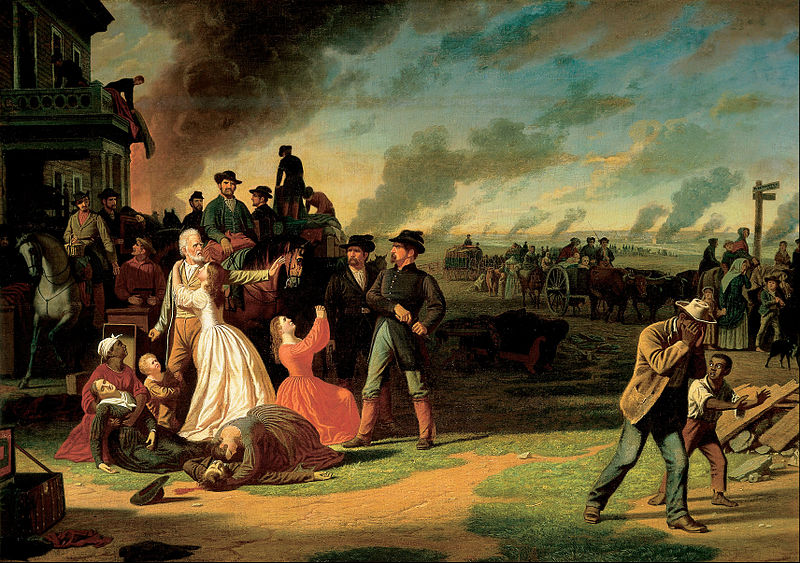
However, just as many, if not more, observers condemned the artist for reviving the bitterness of the recent war, and some critics thought Bingham had sacrificed his art for the sake of politics.
One prominent critic of Bingham's painting was a writer for the St. Louis Democrat, who editorialized on March 11, 1869, that Bingham had "desecrated his art to perpetuate a diseased idea on an historical event. The picture is not true to the sentiment of the times nor to the facts." The critic thought the painting unfairly depicted Union soldiers in general as heartless villains.
Bingham wrote a letter the very next day responding to the writer's criticism, calling it "grossly unjust." Bingham thought the critic either completely misunderstood the painting or willfully misrepresented it. Bingham said that he himself was a Union soldier during the war and that he would never disparage regular Federal soldiers. However, he contended that most of the work carrying out Order No. 11 was done by jayhawkers, Red Legs, and other irregular or outlaw Federal bands
Although Bingham continued to forcefully defend his painting, his career as an artist, in the end, arguably suffered more because of the painting, which came to be called "Order No. 11," than Ewing's political career did. Ewing went on to serve two terms as a US congressman from Ohio and, running as a Democrat in 1879, he narrowly lost a bid to become the state's governor. Whether "Order No. 11" contributed to that defeat is a subject of some scholarly debate. Meanwhile, Bingham's career as an artist suffered after the release of "Order No. 11." During the remainder of his life, his work was never as highly regarded as it had been before the controversial painting, although interest in his art did enjoy a revival long after his death.
Bingham wrote a letter the very next day responding to the writer's criticism, calling it "grossly unjust." Bingham thought the critic either completely misunderstood the painting or willfully misrepresented it. Bingham said that he himself was a Union soldier during the war and that he would never disparage regular Federal soldiers. However, he contended that most of the work carrying out Order No. 11 was done by jayhawkers, Red Legs, and other irregular or outlaw Federal bands
Although Bingham continued to forcefully defend his painting, his career as an artist, in the end, arguably suffered more because of the painting, which came to be called "Order No. 11," than Ewing's political career did. Ewing went on to serve two terms as a US congressman from Ohio and, running as a Democrat in 1879, he narrowly lost a bid to become the state's governor. Whether "Order No. 11" contributed to that defeat is a subject of some scholarly debate. Meanwhile, Bingham's career as an artist suffered after the release of "Order No. 11." During the remainder of his life, his work was never as highly regarded as it had been before the controversial painting, although interest in his art did enjoy a revival long after his death.
Saturday, September 24, 2022
Murder of the Malcolm Logan Family and a Subsequent Lynching
About 3:15 a.m. on Wednesday morning, September 22, 1886, the crew of an eastbound passenger train on the Frisco Railroad about four or five miles east of Cuba, Missouri, spotted a body stretched across the tracks in front of them, but too late to stop. The train passed over the body, severing the head, one foot, and one hand before coming to a stop. Investigation revealed that the victim was already dead when the train passed over him and that he had been murdered. Articles of the man's clothing were found nearby, including a hat. A deep gash in his head that appeared to have been inflicted by a hatchet or similar instrument matched the location of a slit or cut in the hat that had apparently been made by the same instrument.
About 5 a.m., while investigation into the dead man's identity was still ongoing, a fire was discovered at the home of Malcolm Logan about a mile north of the murder scene on the old St. Louis to Springfield wagon road. Hurrying to the scene, neighbors found the house completely engulfed in flames. They could see the body of a woman inside the house, but the blaze was too intense for them to reach it. After the flames died down, the woman's body and those of four children were dragged from the embers. The woman was identified as 39-year-old Ann Logan. The children were identified as Ann's six-year-old son, her six-year-old adopted daughter, her two-year-old daughter, and her infant child ten months of age. Ann and her husband, Malcolm, also had an adopted son who'd spent the night with neighbors and was among those who discovered the fire. Found among the remains of the fire near where Ann Logan's body had been discovered was a hatchet.
After the victim found on the Frisco tracks was identified later that morning as Malcolm Logan, it was theorized that the same person who killed him had also killed his family. It was thought that the murderer had somehow lured Logan away from his home, killed him with the hatchet, and then returned to his house and killed the rest of the Logan family with the same weapon, before discarding it and the setting the house on fire.
Suspicion soon settled on 26-year-old Patrick Wallace, whose father lived near the railroad tracks where Logan's body was found. A witness came forward to say that he had seen Wallace with Malcolm Logan shortly before dark on the evening of September 21. When Wallace was arrested in St. Louis on Thursday, September 23, he claimed he'd been in St. Louis continuously since Monday, but the hotel register did not bear this out. It showed he'd spent Monday night in St. Louis but had been away on Tuesday, the night of the murder, and had come back on Wednesday. In addition, a witness came forward who had seen Wallace on a train bound for Cuba on Tuesday when he claimed he was in St. Louis.
Authorities thought robbery was the motive for the crime. Logan was known, or at least rumored, to have a lot of money, and Wallace, a ne'er do-well with "an uncontrollable thirst for drink, was well acquainted with this fact.
Wallace was brought back to Crawford County and lodged in the county jail at Steelville. Rumors of mob violence began to circulate almost immediately, and on the night of September 30, a mob took Wallace out of jail and strung him up until he was almost unconscious in an effort to get a confession out of him. He finally admitted he had come to Cuba on the evening of the murder, but he still insisted on his innocence, trying instead to cast suspicion on a young black man of his acquaintance named Sam Vaughn. Wallace said the reason he'd lied about his movements before was that Vaughn had paid him not to say anything about seeing him (Vaughn) on the night in question. The vigilantes did not believe Wallace's story, but they were not entirely sure of his guilt either, and a local judge and the county sheriff finally convinced them to cease and desist.
Just a few days later, though, on the late night of October 4, a smaller but more determined mob came back to Steelville and broke the prisoner out of his cell. They took him about two miles north of Steelville and hung him to a railroad trestle over the Meramec River shortly after midnight on the 5th.
A coroner's jury later on the 5th ruled, not surprisingly, that Wallace had come to his death "by hanging at the hand of parties to the jury unknown."
About 5 a.m., while investigation into the dead man's identity was still ongoing, a fire was discovered at the home of Malcolm Logan about a mile north of the murder scene on the old St. Louis to Springfield wagon road. Hurrying to the scene, neighbors found the house completely engulfed in flames. They could see the body of a woman inside the house, but the blaze was too intense for them to reach it. After the flames died down, the woman's body and those of four children were dragged from the embers. The woman was identified as 39-year-old Ann Logan. The children were identified as Ann's six-year-old son, her six-year-old adopted daughter, her two-year-old daughter, and her infant child ten months of age. Ann and her husband, Malcolm, also had an adopted son who'd spent the night with neighbors and was among those who discovered the fire. Found among the remains of the fire near where Ann Logan's body had been discovered was a hatchet.
After the victim found on the Frisco tracks was identified later that morning as Malcolm Logan, it was theorized that the same person who killed him had also killed his family. It was thought that the murderer had somehow lured Logan away from his home, killed him with the hatchet, and then returned to his house and killed the rest of the Logan family with the same weapon, before discarding it and the setting the house on fire.
Suspicion soon settled on 26-year-old Patrick Wallace, whose father lived near the railroad tracks where Logan's body was found. A witness came forward to say that he had seen Wallace with Malcolm Logan shortly before dark on the evening of September 21. When Wallace was arrested in St. Louis on Thursday, September 23, he claimed he'd been in St. Louis continuously since Monday, but the hotel register did not bear this out. It showed he'd spent Monday night in St. Louis but had been away on Tuesday, the night of the murder, and had come back on Wednesday. In addition, a witness came forward who had seen Wallace on a train bound for Cuba on Tuesday when he claimed he was in St. Louis.
Authorities thought robbery was the motive for the crime. Logan was known, or at least rumored, to have a lot of money, and Wallace, a ne'er do-well with "an uncontrollable thirst for drink, was well acquainted with this fact.
Wallace was brought back to Crawford County and lodged in the county jail at Steelville. Rumors of mob violence began to circulate almost immediately, and on the night of September 30, a mob took Wallace out of jail and strung him up until he was almost unconscious in an effort to get a confession out of him. He finally admitted he had come to Cuba on the evening of the murder, but he still insisted on his innocence, trying instead to cast suspicion on a young black man of his acquaintance named Sam Vaughn. Wallace said the reason he'd lied about his movements before was that Vaughn had paid him not to say anything about seeing him (Vaughn) on the night in question. The vigilantes did not believe Wallace's story, but they were not entirely sure of his guilt either, and a local judge and the county sheriff finally convinced them to cease and desist.
Just a few days later, though, on the late night of October 4, a smaller but more determined mob came back to Steelville and broke the prisoner out of his cell. They took him about two miles north of Steelville and hung him to a railroad trestle over the Meramec River shortly after midnight on the 5th.
A coroner's jury later on the 5th ruled, not surprisingly, that Wallace had come to his death "by hanging at the hand of parties to the jury unknown."
Subscribe to:
Posts (Atom)